

How to Guide: Make Your Yoga Mat Work on Carpet
If you have carpet at home, a yoga mat on carpet works for most people, with one condition: skip the thick, squishy mats and go dense. Balance-heavy or dynamic practice needs a heavier, denser natural rubber mat.
TL;DR:
- A dense, natural rubber yoga mat of at least 5 pounds is recommended for stability on carpet, especially for dynamic or balance-heavy practices.
- Dense mats between 3 and 5 millimeters perform better than fluffy foam mats, which tend to cause instability by adding excessive compression.
- Using a non-slip rug pad or flat plywood board under the mat may significantly improves grip and stability, especially on high-pile or shag carpets.
- Regular vacuuming and cleaning of the carpet and mat prolong stability and grip, as dust and pet hair reduce traction.
- For restorative practices or gentle sequences, you'll have more mat options available to use on carpet but for advanced poses and quick transitions, you'll need a denser more stable mat.
Table of Contents
- Why carpet changes how a yoga mat grips the floor
- What mat features matter most for carpeted floors
- How do you choose the right mat for your carpet type?
- Practical fixes that often beat buying a new mat
- Keeping your mat and carpet performing well together
- Why cork and natural rubber suit carpeted practice
- Adapting your poses to a carpeted surface
- Which yoga styles work best on carpet, and when to switch to hardwood
- Safety considerations for practising yoga on carpet
- How carpet thickness and pile type change what you need
- Purpose-built carpet mats versus a standard mat done right
- Carpet isn’t the obstacle you think it is
- Where to find a Crk mat built for your carpet setup
- Sources
Why carpet changes how a yoga mat grips the floor
Hardwood floors work by friction and a flat, high density mat seals against a flat surface. Carpet doesn’t play that game. Instead, grip depends on weight, base texture, and how the mat’s underside interacts with carpet pile.
A soft, thick mat resting on carpet creates what amounts to two cushions stacked on top of each other. The mat sits on top of the carpet layer beneath it, and your standing leg sinks into both layers, creating little to no stability during standing poses, like lunge or tree pose. This is why a thicker mat isn’t automatically better on carpet — past a certain point, more foam just adds more instability, without increasing comfort.
Pile height matters too. Low-pile carpet (think office-style loop carpet or a thin residential weave) behaves almost like a firm surface once you add a dense mat. High-pile or shag carpet swallows a mat’s edges and lets it drift with every shift of weight. Dust and pet hair make things worse by acting like tiny ball bearings between mat and fibre, cutting traction even on mats that grip well elsewhere.
A quick test tells you what you’re working with:
- Press your palm flat into the carpet and count how far it sinks before hitting resistance.
- Run your hand across the pile. If loose fibres or dust cling to your palm, vacuum before every session.
- Lay a mat down and do a slow lunge. Watch whether the mat’s edge lifts or bunches as your weight shifts forward.
If the mat bunches or slides in that last test, the fix is almost never a thicker mat. It’s a denser one.
What mat features matter most for carpeted floors
Shopping for a mat that performs on carpet means ignoring most of what mat marketing usually pushes. Colour, pattern, and surface texture on top don’t move the needle. What matters is underneath.
Material. Open-cell natural rubber is the standard for a reason. It’s naturally tacky, dense, and it slightly conforms to whatever it sits on rather than sliding across it. If you have a latex sensitivity, dense TPE may be an option, though it typically won’t match rubber’s stability on soft or uneven surfaces.
Density and weight. This is the detail most buyers skip and the one that matters most. A heavier mat resists sliding because inertia works in your favour, and a denser mat resists sinking into carpet pile because there’s less air and foam to compress. Buying guides focused specifically on carpet performance consistently point to mats in the 5+ lb range built on natural rubber bases as the more reliable choice over lighter, foam-heavy alternatives.
Thickness. Generally, the more shaggy and soft your carpet is, the more high density rubber you'll want to counter this softness, to add support. While some instability is inevitable, the more soft and fluffy your carpet is, the less likely you will feel it when you have a thick and dense enough layer between you and that carpet. If you find that thick mats, over 4mm do not offer enough stability, then you might consider a thin slab of plywood between your yoga mat and carpet.
Underside texture. A flat, slightly textured open-cell rubber base tends to outperform foam mats, even those with suction grip. Round peaks on the underside of your yoga mat may improve grip to hardwood by creating suction between your mat and the floor, but they do not work on carpet, and will likely make the surface feel even more uneven.
Size. A wider, longer mat means fewer moments where your hand or foot lands off the edge and directly on carpet mid-pose, which is one of the more common causes of a sudden wobble in balancing poses.
Pro Tip: Before buying anything, check whether a product page actually states the base material and weight. If a listing only shows top-surface colour photos and skips the underside description entirely, that may be a sign the mat is made of cheap, foam materials that won't offer support on carpet floors.
How do you choose the right mat for your carpet type?
Start with your practice style, not the mat catalogue. Here’s a short decision path:
- Identify your primary practice. Restorative, yin, or gentle flow gives you many more options since stability is less of an issue. Vinyasa, power yoga, or anything balance-heavy needs a reasonably thick and stable, high density base.
- Check your carpet’s pile. Run the palm test from the section above. Low-pile carpet needs less intervention; high-pile or shag carpet almost always needs a mat plus a fix, like an extra piece of plywood.
- Match density and thickness to what you found. Dynamic practice on high-pile carpet calls for a dense mat around 4 to 5 millimetres, often paired with a rug pad. Gentle practice on low-pile carpet can work with a thinner dense mat alone.
- Ask a few questions before buying: Does the listing mention a latex-free option if you need one? Do you need extra cushioning at the knees or wrists for joint sensitivity? Will you be rolling this mat up and travelling with it, or is it staying in one room?
Watch for red flags while shopping online. A product description heavy on colour options and lifestyle photography but silent on base material, weight, or density is a description written by a marketing team, not a mat that’s been tested for functionality.
Once a mat arrives, a simple press test confirms whether it’s dense enough: push down with your palm. If the mat feels squishy and provides zero resistance, it’s likely too soft for your surface. The best test is to simply try out a couple sun sal's and standing balancing postures, so you will know right away how it feels. If you are seriously struggling in postures that would normally be easy, you might consider looking for yoga mat alternatives that provide better support.
Practical fixes that often beat buying a new mat
If you already have bought a high quality, high density mat for your carpet than you've already taken a solid step in the right direction. However, sometimes a thin non-slip rug pad or plywood may help to cut out any leftover softness, especially if you are a serious yogi. This will only be necessary if your carpet is extremely thick and fluffy.
- Rug pad: Choose a thin and hard rubber pad. Trim as needed and place it directly between your mat and the carpet.
- Plywood or yoga board: For high-pile or shag carpet, a flat board under your mat restores a firm, even surface. DIY yoga board plans typically run about the size of a standard mat and store easily leaned against a wall or slid under a bed.
- Positioning: Set your mat against a wall so one edge has a hard stop, and lay it across the carpet’s grain rather than with it, which resists directional bunching.
- Mat towel on top: A grippy towel over your existing mat may help to keep things clean during sweaty vinyasa practice, but it may only worsen a mat that’s already sinking into your carpet.
Keeping your mat and carpet performing well together
Vacuum your practice zone before sessions, not just occasionally. Dust and hair reduce traction on carpet the same way they reduce it on a mat’s surface, and a cleaner pile gives any mat a better shot at gripping.
- Wipe cork and natural rubber mats with a damp cloth and diluted cleaner, then air dry fully before rolling.
- Store mats unrolled or loosely rolled for better airflow.
- If a mat’s surface feels noticeably softer or thinner than when new, or the base has started flaking, retire it. A mat that’s lost density on carpet reintroduces the exact instability you were trying to avoid.
Carpet is also worth a mention on the health side. The American Lung Association notes that carpets trap dust, allergens, and other pollutants that affect indoor air quality, so regular vacuuming does double duty: better air, better grip.
Why cork and natural rubber suit carpeted practice
Cork’s texture naturally resists slipping even when your hands and feet are damp, and it sits on a natural rubber base dense enough to avoid sinking deep into carpet pile the way lighter foam mats do. That open-cell rubber base also holds its shape while providing a smooth surface over soft carpet. The cork also has some natural hardness due to it being made from tree bark that even further supports your practice.
Crk builds this combination into three mats, each suited to a different setup. The Standard Mat, at 4 millimetres, supports mixed gentle-to-intense practice on low or medium pile carpet, and includes an alignment guide system for cueing hand and foot placement. The Wave Mat offers the same 4 millimetre profile with recycled natural rubber for anyone prioritizing sustainable materials without giving up density. The Flowers Mat, at 5 millimetres, adds a touch more cushioning for restorative sessions or carpet with a slightly deeper pile. All three include antimicrobial surface properties, useful if you sweat through hot yoga or frequent sessions on the same mat.
Adapting your poses to a carpeted surface
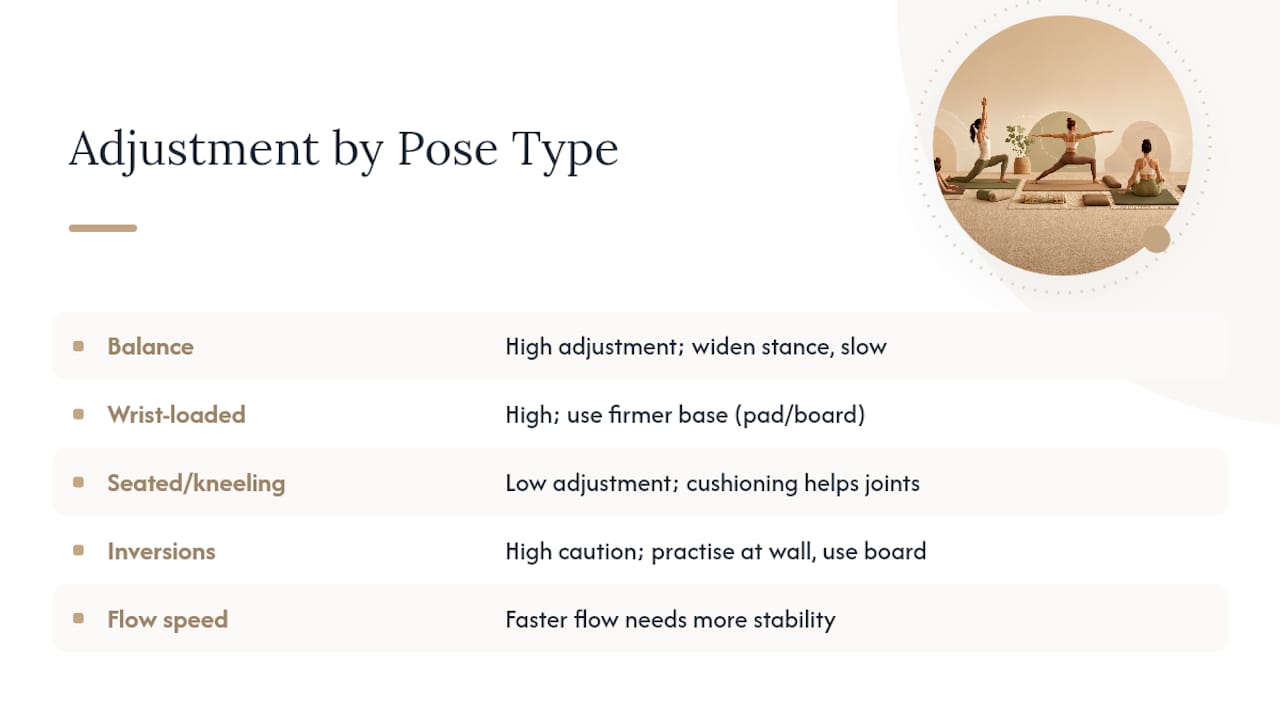
Balance poses need the most adjustment on carpet. Tree pose, eagle, and standing splits ask your standing foot to find a stable edge, and carpet’s give makes that edge less defined. Widen your stance slightly and slow the transition into the pose rather than stepping in quickly.
Wrist-loaded poses like plank, downward dog, and chaturanga transitions benefit from a firmer base underneath, since carpet’s cushioning can let wrists sink at an angle that adds strain. This is one place where a rug pad or plywood board earns its keep, restoring a flatter plane for your hands to press against.
Seated and kneeling poses generally need the least adjustment. Carpet’s extra give under the knees or sit bones is often a benefit here, particularly for anyone with sensitive joints doing hip openers or seated forward folds.
For inversions, carpet may be even more advantageous since it provides a soft cushion for your head and neck in headstands and extra cushion in case of falls. It is recommended to use a wall though if you are at risk of falling.
Flow sequences that move quickly between poses (common in vinyasa) put more demand on quick, confident footing than a slow-paced restorative sequence does, so the mat stability on your carpet matters more the faster your practice moves.
Which yoga styles work best on carpet, and when to switch to hardwood
Restorative yoga, yin yoga, gentle hatha, and most seated or floor-based sequences in pilates work well on carpet, often with a mat of any thickness, made of a wide range of materials. The extra give underneath supports longer holds and reduces pressure on the knees, hips, and tailbone.
Vinyasa, power yoga, and ashtanga are trickier. These styles rely on quick transitions, jump-backs, and repeated weight shifts that punish an unstable base. They’re not impossible on carpet, but they need the denser mat and possibly an extra base to feel safe rather than shaky. Carpet adds a second variable during high intensity, sweaty practice: moisture soaking into carpet fibres underneath a mat over repeated sessions can encourage odour and mildew. If you practise power yoga regularly at home, an extra pad between your mat and the floor is even more worth prioritizing, to protect the carpet from moisture.
Balance-focused practices like arm balances or advanced inversion work benefit from the added softness of carpet, and may only be minimally impacted by soft floors. If the floor is too soft though, and pressure points in the hands completely sink into the fabric, then an extra pad is needed, same as it would be in standing balancing postures.
Safety considerations for practising yoga on carpet
The biggest risk on carpet is falling and improper form due to lack of proper support. Practitioners and movement therapists caution that excessively soft mats on carpet can raise this risk during balance work and flows, because a soft, deep base reduces the proprioceptive and causes your body to sink into certain pressure points. You may find yourself leaning too far forward or back when the ground beneath you is giving way rather than supporting your full weight, distributed evenly.
A few habits reduce that risk meaningfully:
- Warm up joints more thoroughly than you might on a hard floor, since carpet’s give means your stabilizer muscles work harder from the first pose.
- Skip advanced balance and inversion work on carpet until you've determined that there is enough stability beneath you to ensure safety and prevent falls.
- Use targeted cushioning (a folded blanket at the knees, a block under a hand) rather than a softer or thicker mat when a specific joint needs relief.
- Embrace the wobble a little bit since this extra instability acts as a challenge that can significantly improve your core stability by making your tiny stabilizer muscles work that much harder, which can help you to become even more proficient in yoga poses than ever before.
Your carpet is not inherently dangerous. It just makes it a surface with a different set of rules, which mostly comes down to matching mat density, thickness and material to the demands of your practice.
How carpet thickness and pile type change what you need
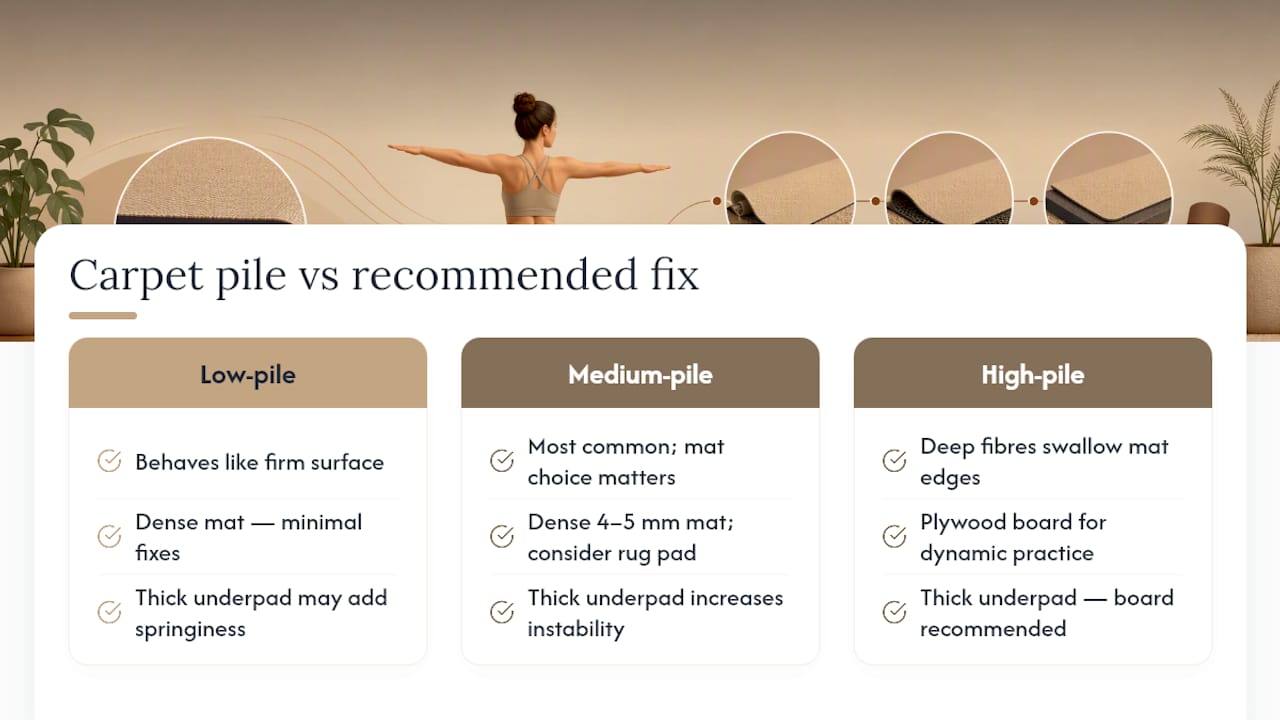
Low-pile carpet, the kind common in offices and some newer residential builds, behaves close to a firm surface once a dense mat is added. You’ll likely need minimal additional fixes here.
Medium-pile residential carpet, the most common type in living rooms and bedrooms, is where mat choice matters most. A dense 4 to 5 millimetre mat usually handles it well, but a rug pad is a reasonable first upgrade if you notice any instability.
High-pile and shag carpet present the biggest challenge. The deep fibres swallow a mat’s edges, and even dense mats can shift during dynamic sequences. For this carpet type, a plywood board is the most reliable long-term fix for this carpet type if you practise anything beyond gentle or restorative styles.
Carpet padding underneath (the layer between carpet and subfloor, distinct from a rug pad on top) adds another variable. A thick, plush pad under carpet makes the whole floor feel springier, which compounds instability the same way an overly thick mat does. If your home has notably bouncy carpet, lean toward the board solution rather than trying to solve it with mat choice alone.
Purpose-built carpet mats versus a standard mat done right
Some brands market mats specifically labelled for carpet use, often at a premium price. In practice, what actually matters is the same handful of specs any careful buyer should check regardless of labelling: base material, density, weight, and thickness.
| Consideration | Carpet-optimized claim | What actually determines performance |
|---|---|---|
| Best for | Marketed broadly, sometimes vaguely | Depends on your specific practice style and pile height |
| Thickness/density | Often not detailed | Dense, moderate thickness (4 to 6 mm) outperforms thick and soft |
| Underside material/grip | Sometimes highlighted, sometimes not | Open-cell natural rubber base is the consistent performer |
| Weight/stability | Rarely a headline feature | Heavier mats (5+ lb) resist sliding better than light foam mats |
| Maintenance/cleaning | Varies by material | Natural rubber and cork clean easily with diluted cleaner and wash cloth |
A standard dense natural rubber mat, chosen with carpet’s demands in mind, generally performs as well as anything marketed with a carpet-specific label. The label isn’t the thing that matters. The base material and density underneath it are.
Carpet isn’t the obstacle you think it is
Carpet gets treated online like a problem to route around, and that framing misses the point. It’s a surface with its own characteristics, and once you understand those, most of the frustration disappears. The failures people report almost always trace back to one choice: buying a thick, plush mat because it felt comfortable in the store, then wondering why it wobbles at home.
These cork and natural rubber mats were built around grip and reduced chemical exposure, not around carpet specifically, but density and a proper natural rubber base happen to be exactly what carpet performance requires. That’s not a coincidence so much as a reason to trust materials chosen for grip in the first place.
If you’re on the fence, try the cheap fix before making an investment. A solid rug pad under your current mat, gives your setup the refresh that it needs without another round of online research.
— Crk
Where to find a Crk mat built for your carpet setup
The switch to a carpet-friendly mat is straightforward, without asking you to guess at specs that product listings usually leave out. Every mat is built on the same dense cork and natural rubber base that this article recommends for soft surfaces, so you’re choosing between thickness and finish, not gambling on whether the underside will actually grip and provide a stable support.
The Standard Mat is the 4 millimetre pick for most home setups, especially mixed practice on low to medium pile carpet. The Wave Mat matches that same 4 millimetre profile with recycled natural rubber, a good fit if sustainable sourcing is a priority alongside grip. The Flowers Mat, at 5 millimetres, suits restorative or gentle sessions on carpet with a bit more give, where the extra cushioning works in your favour rather than against it.
Check the product pages for full material specs and current guarantee details before you order, and if you’re still deciding between styles, the full mat lineup lays out every option side by side.
Sources
- Can You Do Yoga on Carpet? Setup, Mats & Tips
- Best Yoga Mat for Carpet: Your 2026 Home Practice Guide
- Yoga board DIY (shopify-hosted PDF)
- Indoor air pollutants: carpets — American Lung Association


