

Sweat Proof Grip, Eco Wins: Cork Vs Rubber Yoga Mat, Cork Over Rubber
Cork wins for hot yoga and heavy-sweat practice because its surface grips harder as it gets damp. Rubber wins for dry-room work and joint-heavy sequences because it delivers more cushioning and immediate tack. Anyone with a latex sensitivity should check the base layer first, since most rubber mats (and some cork mats) use natural rubber. Crk builds its mats with a cork top over a rubber or recycled-rubber base to cover both needs at once.
TL;DR:
- Cork mats enhance grip as they get damp, making them ideal for hot yoga, while rubber mats provide consistent dry grip and more cushioning for dry-room practices.
- Rubber offers better impact absorption and joint protection with thicker options, but cork over rubber hybrid mats strike a balance for versatile use.
- Durability varies more by construction than material, with layered mats wearing out within four to six years of regular use, while dense rubber can last longer.
- Natural cork is highly sustainable, regrowing bark after harvest, but latex sensitivity requires choosing cork-top over natural rubber bases.
- For practices with heavy sweating, matching the mat material to your moisture profile—cork for hot classes, rubber for dry—is essential to prevent slipping and ensure safety.
Table of Contents
- Cork vs rubber yoga mat comparison at a glance
- How do cork and rubber mats grip differently when you sweat?
- Which mat protects your knees and wrists better?
- How long do cork and rubber yoga mats actually last?
- Does mat weight actually matter for your routine?
- How do you clean and maintain each mat type?
- Are cork and rubber mats actually eco-friendly?
- Which yoga mat should you buy: a quick decision checklist
- How Crk’s cork-over-rubber mats match these buying criteria
- Editorial take: stop treating grip as a fixed property
- Shop Crk’s cork and rubber yoga mats
- Sources
- FAQ
Cork vs rubber yoga mat comparison at a glance
Grip, cushioning, and cleanup routines vary enough between these two materials that picking the wrong one changes how your practice actually feels, not just how the mat looks in a studio bag.
- Grip (dry): Rubber grips well right away. Cork feels smoother and slightly slicker until it warms up or picks up moisture.
- Grip (wet): Cork improves as it dampens, thanks to the suberin in its surface. Rubber can lose tack once sweat pools unless you towel it down.
- Cushioning: Standard rubber bases usually offer more give and joint protection than cork-top mats.
- Durability: Cork-over-rubber and natural rubber mats often perform for years with care; dense closed-cell mats can outlast grippy-top layered mats, which commonly wear down in four to six years of regular use.
- Weight: Cork-and-rubber builds trend heavier than foam or TPE mats.
- Maintenance: Cork resists odour and microbial buildup with minimal upkeep. Rubber needs regular wipe-downs, especially during its break-in period.
- Sustainability: Cork bark regrows after harvest. Natural rubber is renewable but recycling infrastructure for either material remains limited.
For hot vinyasa or Bikram, cork is the safer bet. For restorative or alignment-focused dry-room classes, rubber’s cushioning usually wins.
How do cork and rubber mats grip differently when you sweat?
Cork behaves almost backwards from what most new buyers expect. A dry cork surface feels a bit smooth, even faintly slippery, during the first few sun salutations. Once your palms and feet start sweating, that same surface grips harder. The mechanism comes down to suberin, a natural compound in cork bark that reacts to moisture, combined with cork’s slightly textured surface, which becomes tackier as it dampens, according to a detailed comparison of cork mat construction. That is why cork or PU-topped mats consistently show up as top recommendations for heated-room practice.
Rubber works on the opposite curve. A natural rubber mat is tacky the moment you unroll it, because rubber is open-cell and grips well dry. That advantage fades as sweat accumulates on the surface rather than absorbing into it. Heavy sweaters in a rubber-only mat often find themselves sliding out of downward dog by the second half of class unless they towel off or lay a grip towel over the top.
Two quick tests tell you which surface suits you before you buy:
- Mist a small patch with water from a spray bottle and press your palm down. If grip improves, you lean cork. If it gets slick, you lean rubber, and you’ll want a towel strategy.
- Do a five-minute sun salutation sequence on each mat type in a studio if you can, paying attention to your hands specifically, since palms tend to sweat before feet do.
Pro Tip: If you split your practice between hot and regular-temperature classes, a cork top over a natural rubber base gives you rubber’s cushioning with cork’s wet-weather grip, which is exactly why that hybrid construction has become the default for serious hot-yoga practitioners.
Which mat protects your knees and wrists better?
Cushioning is where rubber typically pulls ahead. Dense rubber bases compress and rebound under pressure, giving kneeling poses like camel or low lunge more spring than a standard cork-top mat delivers. Cork itself is a fairly firm material; the cushioning in a cork mat comes almost entirely from whatever base it’s bonded to; a cork top over a rubber base cushions differently than the same top over a thin foam layer.
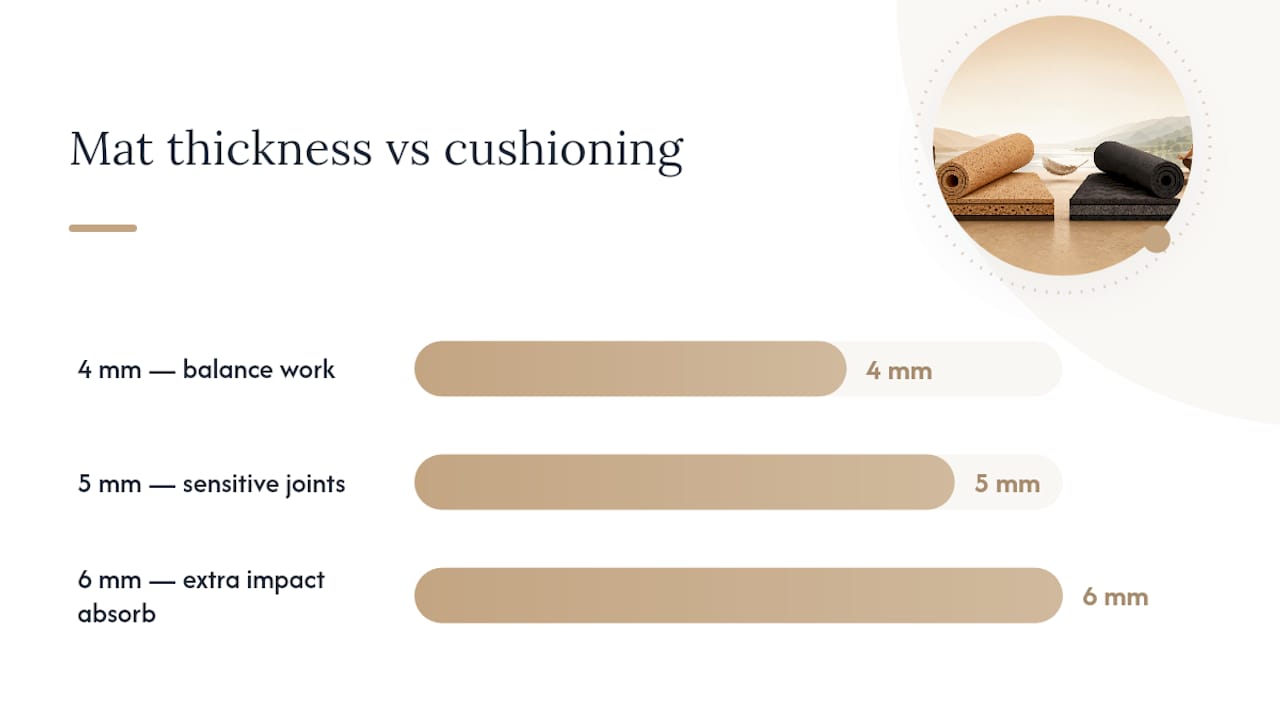
Thickness matters as much as material here:
- 4mm mats suit practitioners who prioritize ground connection and balance work. Standing poses and arm balances feel more stable when you’re closer to the floor.
- 5 to 6mm mats suit anyone with sensitive knees, wrists, or a lower-back history. The extra material absorbs impact during kneeling transitions and long holds in poses like pigeon.
If you already own a firmer cork mat and your joints are complaining, you don’t necessarily need to replace it. A folded towel under the knees during kneeling sequences, or a set of cork blocks under the hands during forward folds, closes most of the comfort gap without buying new gear. Crk’s 5mm Flowers Mat is built specifically for that thicker-cushion profile, for readers who’d rather solve it with thickness than accessories.
How long do cork and rubber yoga mats actually last?
Lifespan depends more on construction than on cork versus rubber as a simple binary. Cork-over-rubber mats and natural rubber mats generally hold up well with consistent care, while grippy-top layered mats, including some PU and rubber hybrids, commonly wear down within four to six years of regular studio use. Dense closed-cell PVC mats can last a decade or longer, but they come with the trade-off of less natural grip and a less sustainable material profile.
Watch for three signs your mat is past its prime:
- Grip loss on the top layer. If your hands or feet start sliding in poses that used to feel solid, the surface texture has worn smooth.
- Staining or discolouration. Sweat and oils build up over time, particularly on lighter-coloured cork surfaces.
- Visible compression. Permanent indentations where your hands and feet land most often mean the cushioning layer has broken down.
Storage habits extend usable life more than any single cleaning product does. Keep your mat out of direct sunlight, since UV exposure dries out both cork and rubber and speeds up cracking. Let it dry fully, unrolled, before storing it rolled up. Avoid leaving it in a hot car, which accelerates the same breakdown sunlight causes. A mat cared for this way will consistently outlast one that gets rolled up damp and tossed in a gym bag.
Does mat weight actually matter for your routine?
Cork-and-rubber mats run heavier than foam or TPE alternatives, typically landing in the moderate weight range depending on thickness and size. That weight comes from the density needed for cushioning and durability, so it’s a trade-off rather than a flaw.
For studio-goers who drive or take transit short distances, the extra weight is barely noticeable with a proper strap. For anyone commuting on foot, cycling, or travelling with a mat regularly, a lighter cork-on-TPE hybrid cuts weight without giving up cork’s grip advantages entirely, since TPE bases are a common lighter alternative to natural rubber. Padded carrier straps also make a heavier mat far more manageable than a basic elastic loop.
Heavier mats do have one underrated advantage: they tend to stay flat on the studio floor instead of curling at the corners, which matters more than many expect once you’re mid-pose and the edge of your mat starts creeping.
How do you clean and maintain each mat type?
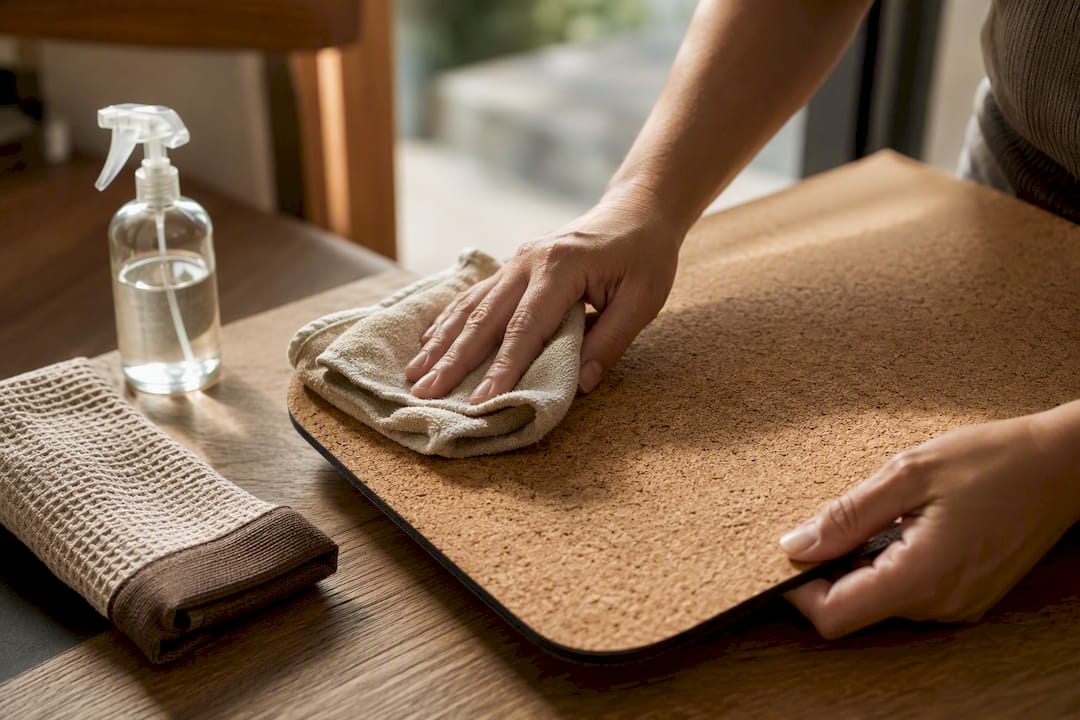
Cork’s biggest practical advantage shows up here, not in a yoga pose. Cork is naturally resistant to odour and microbial growth, which means it needs less aggressive cleaning than absorbent foam or heavily textured rubber tops. That said, staying odour-free long term still depends on your own cleaning habits and how the top layer is finished, not on cork alone.
Natural rubber mats often carry a noticeable smell out of the box, sometimes described as an earthy or tire-like scent. That smell fades over two to four weeks of regular airing and use; it isn’t a sign of a defective mat.
Follow this basic routine for either material:
- Wipe down after every sweaty session with a damp cloth and a small amount of mild, unscented soap.
- Let the mat air-dry fully, unrolled, before rolling it back up.
- Do a deeper clean every few weeks with a diluted vinegar-water solution if odour builds up.
- Store it away from direct sunlight and heat sources.
Pro Tip: Skip essential oils and heavily scented cleaners on cork specifically. Oils can seep into cork’s natural pores and affect grip over time, undoing the exact benefit you bought the mat for.
Avoid bleach and harsh disinfectant sprays on both materials. They break down rubber’s structure faster and can strip cork’s natural surface texture, which is the part doing the grip work in the first place.
Are cork and rubber mats actually eco-friendly?
Cork’s sustainability case is genuinely strong. It’s harvested by stripping bark from cork oak trees without cutting them down, and that bark regrows over several years, making it one of the more renewable materials in the mat category. Natural rubber comes from tapped rubber trees, which is also renewable, though large-scale rubber production raises separate land-use questions, and end-of-life recycling for rubber and cork composites remains limited industry-wide.
Latex allergy is the other major consideration, and it’s often overlooked until someone breaks out in a rash mid-class. Many natural rubber mats contain latex proteins that trigger reactions in sensitive individuals. If that’s a concern:
- Look for a cork top bonded to a TPE base rather than natural rubber, since that construction avoids latex exposure entirely while keeping cork’s moisture-activated grip.
- Ask suppliers directly whether their rubber is natural latex or a synthetic alternative. Product pages don’t always spell this out.
- Check for any third-party material disclosure rather than relying on marketing language alone.
Buying from a brand that states its material sourcing clearly, cork oak origin, rubber type, and base composition, gives you more confidence than a generic “eco-friendly” label ever will.
Which yoga mat should you buy: a quick decision checklist
Match your practice style to the material before you look at price or colour options. Getting this part right prevents the most common regret buyers report: a mat that looks great but slides out from under them in week two.
- Hot or heavy-sweat vinyasa: Choose cork. Grip improves as you sweat, which is the opposite of what most other materials do.
- Dry-room alignment or restorative practice: Choose rubber for the extra cushioning and immediate tack.
- Sensitive knees or wrists: Choose a 5 to 6mm mat regardless of top material; thickness matters more than surface here.
- Latex allergy: Choose a cork-top mat over a TPE base rather than a natural rubber base.
- Frequent commuting: Choose a lighter cork-on-TPE hybrid over a heavier full-rubber build.
- Sustainability as top priority: Choose cork for its renewable bark harvest, and check whether the rubber base is recycled.
Practice style, sweat level, and allergy risk consistently rank as the primary decision filters buyers should apply before weight, price, or brand enter the conversation. Get those three right first.
How Crk’s cork-over-rubber mats match these buying criteria
Crk builds three mats around the trade-offs covered above, each aimed at a slightly different practice profile. The Standard Mat pairs a 4mm cork top with natural rubber, suited to daily vinyasa or mixed-style practitioners who want balanced grip without extra bulk. The Flowers Mat steps up to 5mm, aimed at anyone prioritizing joint cushioning during kneeling or restorative sequences. The Sun Mat keeps the 4mm cork top but swaps in recycled natural rubber for the base, built for buyers who weigh sustainability as heavily as performance.
All three carry Crk’s alignment guide markings and an antimicrobial cork surface, addressing the odour and grip-loss issues that shorten the usable life of lower-quality mats. If you’re deciding between thicknesses, default to 4mm for general practice and balance work, and move to 5mm if kneeling poses or long holds bother your joints. Sizing across the range stays consistent, so the deciding factor is almost always thickness and base material rather than dimensions.
Editorial take: stop treating grip as a fixed property
Most mat comparisons talk about grip as if it’s one number you can rank materials against. It isn’t. Grip changes throughout a single class as your body heats up and starts sweating, and the material that grips best at minute one is often not the material that grips best at minute forty. That’s the piece the conventional buying advice misses. It tells you “rubber has better grip” without asking better grip when.
The practical fix is simpler than most guides make it sound: match the material to your actual sweat curve, not to a generic durability or price ranking. A dry-room restorative practitioner and a Bikram regular should not be shopping the same mat, even if both call it “yoga.” Cushioning matters too, but it’s a secondary filter, something you solve with thickness or a folded towel. Grip behaviour under moisture is the variable that actually determines whether you spend class focused on your breath or fighting to stay upright. Sort that first, and the rest of the decision gets a lot easier.
— Crk
Shop Crk’s cork and rubber yoga mats
Crk builds every mat around the same idea driving this whole comparison: grip that gets better, not worse, as you sweat, without relying on synthetic materials that off-gas or wear out fast. That’s the practical edge over a standard rubber-only mat once your practice gets hot and heavy.
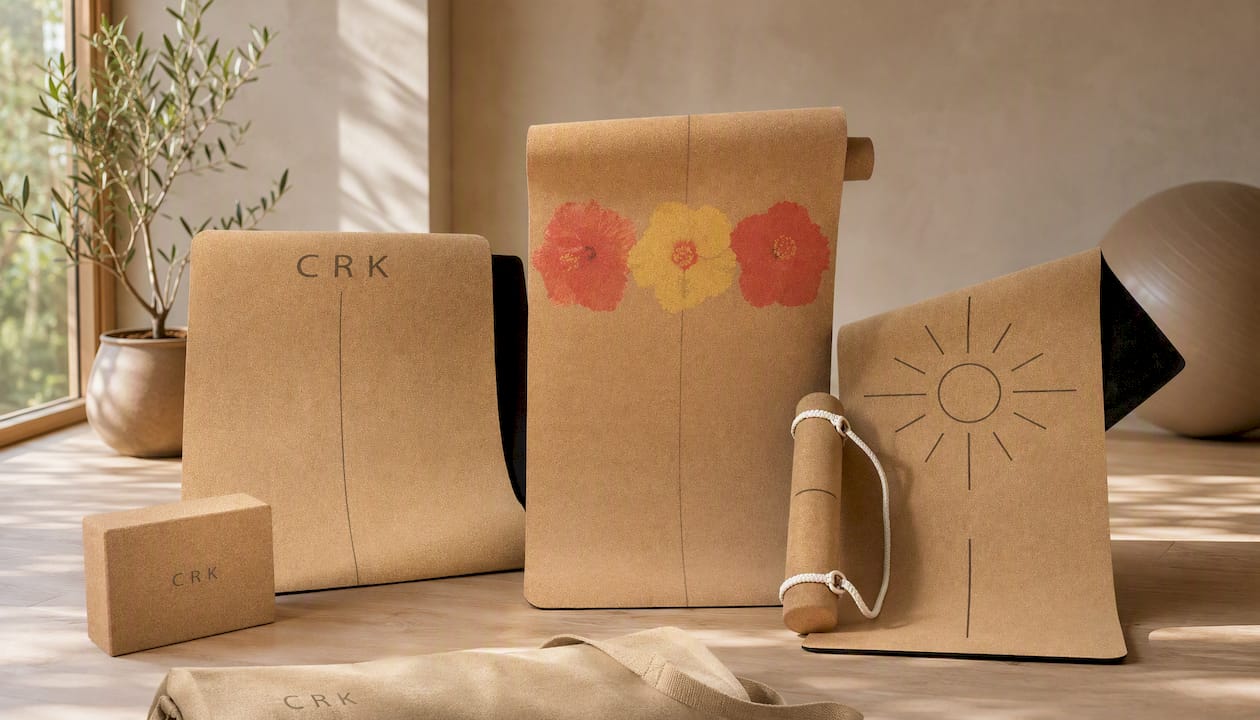
Pick based on how you actually practise. The Standard Mat at 4mm suits daily mixed-style practice and general studio use. The Flowers Mat at 5mm suits anyone who wants more cushioning for kneeling or restorative work. The Sun Mat gives you the same 4mm cork-grip performance with a recycled rubber base, for anyone weighing sustainability heavily in the decision. If you’re shopping for sweat-friendly practice gear beyond the mat itself, moisture-wicking pieces like a flared yoga jumpsuit or a pair of breathable yoga shorts round out a hot-class kit well. Check the size guide on each product page, pick your thickness based on the checklist above, and order the mat that matches your actual practice, not the one with the nicest photo.
Sources
- Cork Yoga Mats: Full Review & Comparison
- Manduka PRO vs Lululemon The Mat 5mm: Which Yoga Mat Should You Buy? | YogaCompare
FAQ
Are cork yoga mats healthier than other materials?
Cork resists odour and microbial growth naturally, which cuts down on the bacteria buildup common in absorbent foam mats. It’s not a health claim beyond that, but the lower-maintenance surface matters if you practise several times a week.
Are cork yoga mats worth the higher price?
For hot yoga or heavy-sweat practice, yes: cork’s moisture-activated grip solves a real slipping problem that rubber alone doesn’t. For dry-room practice where cushioning matters more than wet grip, a quality rubber mat delivers comparable value.
What is the healthiest material for a yoga mat?
Natural cork and natural rubber both avoid the synthetic off-gassing associated with some PVC mats. Anyone with a latex sensitivity should choose a cork top over a TPE base rather than a natural rubber base to avoid allergy risk entirely.
What is the best material for a yoga mat overall?
There’s no single best material. Cork suits sweaty, hot-room practice because grip improves with moisture. Rubber suits dry-room and joint-focused practice because it offers more cushioning and immediate tack. Crk’s cork-over-rubber construction is built to cover both.
Is a cork or rubber mat better for beginners?
Beginners doing a mix of class styles usually do well with a cork-over-rubber hybrid, since it handles both dry warm-ups and sweatier flows without needing a second mat.


