

3mm vs 5mm Yoga Mat: Choose 4mm Cork for Cushion and Stability
Choose 3mm if you want a low, stable base for balance work and travel. Choose 5mm if you want everyday cushioning that protects your knees and wrists on hard floors. The real trade-off is stability versus cushion, and material density often changes that outcome more than the millimetre count itself.
TL;DR:
- A 3mm mat provides better proprioceptive feedback and stability ideal for balance and travel, but offers less cushioning for knees and wrists on hard floors.
- A 5mm mat offers more joint protection and comfort for seated and kneeling poses, especially on tile or concrete, but can feel less stable and heavier to carry.
- Cushioning effectiveness depends on material density and rebound, meaning that a denser 4mm cork over rubber mat can outperform a softer 6mm synthetic mat in support and longevity.
- Testing on your actual practice surface and doing kneel, press, and balance tests ensures a suitable choice, especially for sensitive joints or balance-focused practices.
- Most practitioners benefit from a 4mm mat with high-density material to balance cushioning, floor feedback, and durability, making it a versatile option for varying yoga styles.
Table of Contents
- 3mm vs 5mm yoga mat: pros, cons and best use
- How does thickness affect cushioning and joint protection?
- Why do thinner mats feel more stable?
- Which is easier to carry and travel with?
- Does the mat’s material matter more than its thickness?
- How do you choose between 3mm and 5mm?
- Crk’s perspective: why we build most of our mats at 4mm
- Want one mat that handles most of your practice?
- Sources
3mm vs 5mm yoga mat: pros, cons and best use
A quick side-by-side makes the decision easier before you get into the mechanics of cushioning, stability, and material.
3mm mats:
- Pros: closer floor contact, lighter for carrying, rolls small for a bag or suitcase.
- Cons: less padding under knees and wrists, can feel harsh on concrete or tile.
- Best for: vinyasa flow, balance sequences, travel, studio classes with sprung wood floors.
5mm mats:
- Pros: noticeably more cushion for kneeling and seated poses, forgiving on hard home floors.
- Cons: slightly heavier to carry daily, a touch less ground feedback in standing balance poses.
- Best for: home practice on tile or concrete, mixed styles, beginners easing into floor-based work, anyone with sore knees or wrists.
A few exceptions change this math. Someone practising on a sprung hardwood studio floor needs far less cushioning than someone rolling out a mat on a concrete basement floor. Bodyweight matters too. Heavier practitioners tend to compress a mat further, which can make a soft 5mm mat feel closer to a 3mm mat under sustained pressure. And material density can flip the comparison entirely. This is the piece Kit Authority points to when it calls 3mm to 5mm the standard everyday range, with 3mm suited to feedback and travel and 5mm suited to cushioning for general use.
How does thickness affect cushioning and joint protection?
“Bottoming out” happens when your knee, elbow, or wrist presses straight through the padding and hits the floor underneath. It is the single biggest complaint about thin mats, and it is why cushioning gets so much attention in mat shopping. Compression resistance, meaning how well a material springs back rather than flattening permanently under load, determines how much real protection a mat offers over its lifespan.
A firm 5mm mat is usually enough cushioning for most people doing a mixed practice at home. Yogalith’s buyer’s guide frames 4mm to 5mm as the studio default precisely because it balances knee protection against the need to stay grounded, and recommends stepping up to 6mm or more only for regular restorative work or existing joint sensitivity. If you already have knee pain, tender wrists, or you spend a lot of time in kneeling poses like Camel or low lunge, that extra 1mm to 3mm of padding is worth the trade in ground feel.
You do not need to guess. Test a mat the way you would test a mattress.
- Press test: push your palm flat into the mat with real weight. If you feel the floor immediately, that mat will bottom out fast.
- Kneel test: hold a kneeling position for 20 to 30 seconds. Persistent ache under the kneecap after half a minute is a red flag.
- Pose test: move through a low lunge and a seated forward fold. Watch for pressure points at the knee, ankle bone, or tailbone.
Pro Tip: Test on the actual floor you’ll practise on, not the store’s floor. A mat that feels plush on carpet can feel thin on the tile in your bathroom or living room.
The NCCIH’s overview of yoga safety notes that yoga is generally safe and beneficial for musculoskeletal health when practice and equipment suit the person doing it. Matching mat thickness to your joints is part of that equation, not an afterthought.
Why do thinner mats feel more stable?
A 3mm mat keeps you closer to the floor, and that shorter distance matters more than it sounds. Think of it as a lever arm problem: the thicker the mat, the more your foot or hand can shift and sink before your brain registers the movement. On a thin, firm surface, your nervous system gets clearer proprioceptive signals, meaning it reads pressure and position from the floor faster and more accurately.
That difference shows up clearly in specific poses:
- Tree pose: a soft, thick mat lets your standing foot sink slightly, which can amplify wobble instead of absorbing it.
- Warrior III: the single-leg balance depends on immediate feedback from the floor under your standing foot.
- Hand balances and arm balances: wrists need a firm, unmoving base, since a spongy surface adds instability exactly where you need control.
This is why dedicated balance-focused practitioners often gravitate toward 3mm. Kit Authority specifically calls out 3mm as the choice for a low, precise base, particularly for dynamic or balance-driven practice.
Heavier practitioners should read this with a caveat. More bodyweight means more compression, and a soft 3mm mat can feel unexpectedly unstable if it flattens unevenly under load. Density matters as much as thickness here. A denser 3mm mat holds its shape and gives consistent feedback, while a cheap, soft 3mm mat can feel mushy in exactly the moments you need it to feel firm. If balance is your priority, check firmness before you check the millimetre number on the label.
Which is easier to carry and travel with?
The gap between 3mm and 5mm gets bigger the more you move your mat around. A standard 3mm mat is noticeably lighter and rolls into a smaller diameter, which matters if you’re carrying it across a city on transit or fitting it into a suitcase. A 5mm mat adds bulk that’s barely noticeable rolled out on a studio floor but becomes obvious the tenth time you’re strapping it to a backpack.
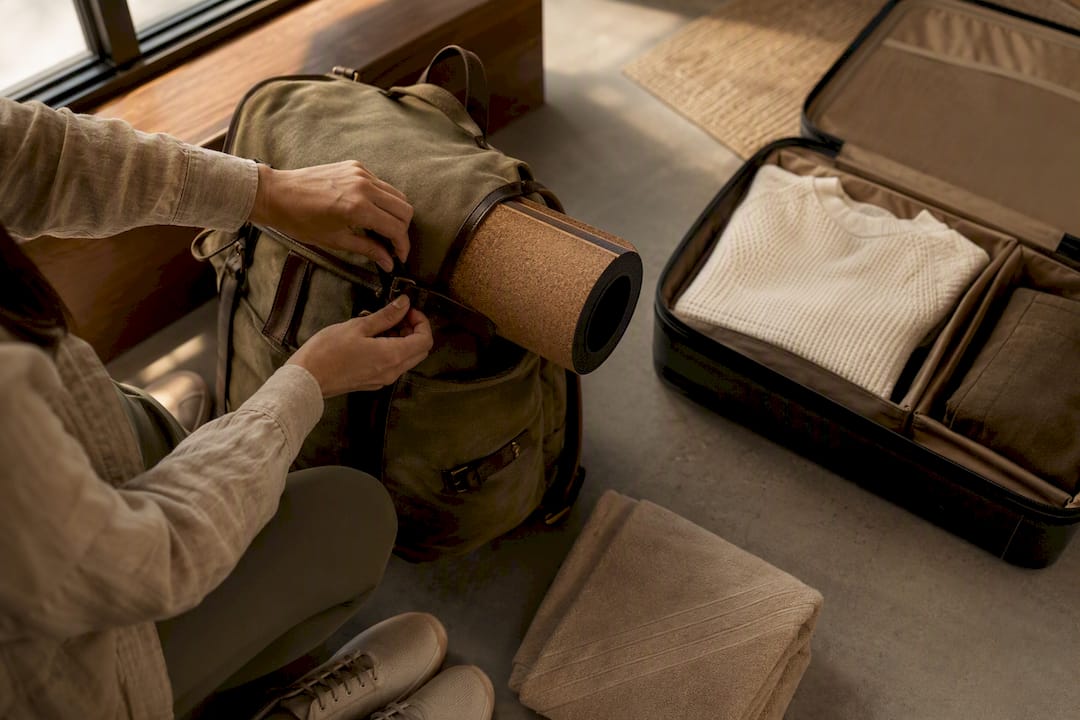
If you practise in more than one setting, a two-mat approach solves the compromise instead of forcing you to pick one. Keep a standard mat for home and a dedicated travel mat for the gym bag, the studio, or the airport. HTSYoga’s guide recommends exactly this split for practitioners who move between settings regularly, since it avoids asking one mat to do two conflicting jobs well.
Quick packing notes for frequent travellers:
- Roll rather than fold. Folding creates permanent creases in rubber and cork mats over time.
- A mat sleeve or strap keeps rolled mats from unrolling in transit, especially on flights with tight overhead bins.
- Check carry-on size limits before assuming a rolled mat fits. Most standard mats are close to the size limit for carry-on bins.
Does the mat’s material matter more than its thickness?
Yes, and this is the part most buyers skip. Two mats listed at 5mm can feel completely different underfoot depending on what they’re made from. Compression resistance and rebound, meaning how a material responds under weight and how quickly it returns to shape afterward, decide whether a mat feels supportive or feels like it’s slowly going flat under you.
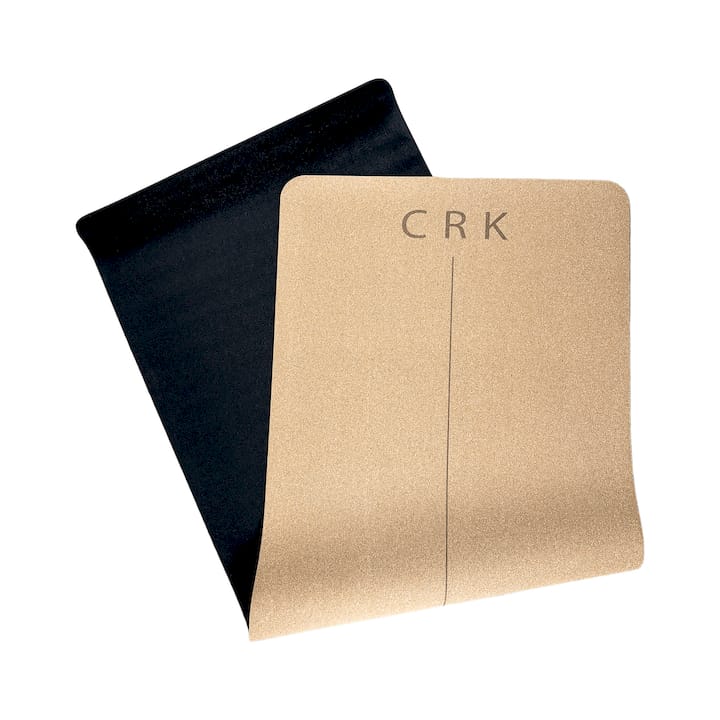
Broad material categories behave in predictable ways. PVC mats tend to be soft and cushioned but can compress permanently over time and often carry a strong chemical smell out of the box. TPE mats are lighter and more eco-friendly than PVC but usually offer less durability. PU-topped mats grip well when dry but can get slick with sweat. Natural rubber and cork combinations behave differently again: cork’s texture actually improves its grip as it absorbs moisture, which makes it counterintuitive for hot yoga or sweaty practice compared with synthetic surfaces that get slippery under the same conditions.
HTSYoga’s comparison makes this point directly: thickness sets the ceiling on cushioning, but density and material decide whether you actually get to use it.
A denser 5mm mat can outperform a soft 6mm mat on both balance and knee protection, because compression resistance, not raw millimetres, is what stops a mat from bottoming out under real weight.
Crk builds its Standard Mat at 4mm using organic cork over natural rubber specifically because that combination holds its shape under sustained kneeling while still keeping practitioners close enough to the floor for balance work. It’s a practical illustration of the point: a well-chosen 4mm mat with the right material can outperform a poorly built 5mm or 6mm mat on both cushioning and stability.
How do you choose between 3mm and 5mm?
Start with how you actually practise, not with a general rule of thumb. A dynamic vinyasa practitioner and a restorative yoga student need different things from the same square footage of rubber.
- Identify your primary use. Balance-heavy or travel-heavy practice points toward 3mm. Mixed practice on a hard home floor points toward 5mm.
- Run the kneel test. Hold a kneeling position for 20 to 30 seconds on the actual floor you’ll use at home, not a showroom floor.
- Run the press test. Push your palm flat into the mat. If you feel the floor instantly, that mat won’t hold up to seated or kneeling work.
- Run a single-leg balance test. Stand on one leg for 15 seconds. Wobble that feels amplified rather than absorbed usually means the mat is too soft, not too thin.
- Apply the decision rule. Travel or balance focus, choose 3mm. Mixed practice with no joint pain, choose 4mm to 5mm. Existing knee or wrist sensitivity, choose 6mm or higher, or a denser 5mm mat.
Pro Tip: If you’re torn between two mats, order both and live with each one for at least three sessions covering standing, kneeling, and seated work before deciding. Bottoming out and grip under sweat rarely show up in a five-minute store test.
Crk’s perspective: why we build most of our mats at 4mm
Most of our mats sit at 4mm on purpose. It’s the point where cushion and floor feedback stop competing and start working together, which is exactly the compromise this whole comparison keeps circling back to. We pair that thickness with organic cork over natural rubber because cork grips better as it absorbs sweat, not worse, and its antimicrobial surface cuts down on the odour and bacteria buildup that plague synthetic mats after a few hot classes. That material choice also means less exposure to the chemical off-gassing common in PVC mats. Customers consistently tell us their mats hold shape and grip session after session, long after a cheaper mat would have gone flat. A 3mm or 5mm mat both have their place. We built ours at 4mm because most practitioners are shopping for one mat that does several jobs well, not a specialist mat for a single use case.
— Crk
Want one mat that handles most of your practice?
If you’ve read this far weighing 3mm against 5mm, there’s a good chance neither extreme fully fits what you actually do. Crk’s Standard Mat sits at 4mm in organic cork and natural rubber, built to give you enough cushion for kneeling work without sacrificing the floor feedback balance poses demand. If alignment cues help your practice, the Summer Mat adds a built-in guide system on the same 4mm recycled natural rubber base. Prefer something design-forward without changing the performance profile? The Wave Mat delivers the same cork-and-rubber cushioning in a different finish. All three come with straightforward care instructions, cork surfaces improve with age rather than degrading, and none of them carry the chemical smell common to PVC mats out of the box. Run the kneel test and press test from earlier in this article on any of them at home. Order now and put it through three real practice sessions before you decide it’s the one.
Sources
- Yoga: effectiveness and safety — NCCIH
- How thick should a yoga mat be — Kit Authority (2026)
- Yoga mat thickness: the definitive buyer’s guide 2026 — Yogalith


