

1.5 kg vs 14 kg: When Cork Is Truly Low Carbon, Ask for an EPD
Yes, cork is sustainable, generally, with real qualifiers attached. Harvesters strip the bark without felling the tree, so a cork oak keeps growing and storing carbon for centuries. Producing 1,000 natural cork wine stoppers emits about 1.5 kg of CO2, against 14 kg for plastic and 37 kg for aluminium. The catch: processing and composite blending can erode that advantage fast.
TL;DR:
- Longer-lasting cork products, such as flooring and wine stoppers, retain most environmental benefits by avoiding energy-intensive processing.
- Certifications like EN 15804, FSC, or PEFC help verify the sustainability claims of cork products and should be checked before purchase.
- End-of-life options for pure cork include biodegradation, recycling, or energy recovery, but bonded or composite cork products often cannot be recycled easily.
- The carbon footprint of producing 1,000 natural cork stoppers is around 1.5 kg of CO2, which is significantly lower than plastic and aluminum alternatives.
- Sustainable cork harvesting relies on hand stripping bark every nine to 12 years without harming the tree, supporting biodiversity and landscape health.
Table of Contents
- Is cork sustainable because of how it’s harvested?
- What do carbon footprint studies actually say about cork?
- Why cork oak forests matter beyond the material itself
- How manufacturing and end-of-life change cork’s footprint
- Which certifications actually verify a cork product’s claims?
- How Crk builds cork into its yoga products
- Where cork earns its reputation, and where to stay skeptical
- Buying cork products that back up the claims
- Sources
- FAQ
Is cork sustainable because of how it’s harvested?
Cork is the bark of Quercus suber, the cork oak tree, stripped by hand roughly every nine to 12 years without harming the tree underneath. A single cork oak can live 150 to 200 years, producing bark for most of that span. No other major packaging or flooring material works this way. Steel gets mined once. Plastic gets refined once. Cork bark regrows on the same living tree, over and over, for generations of harvesters.
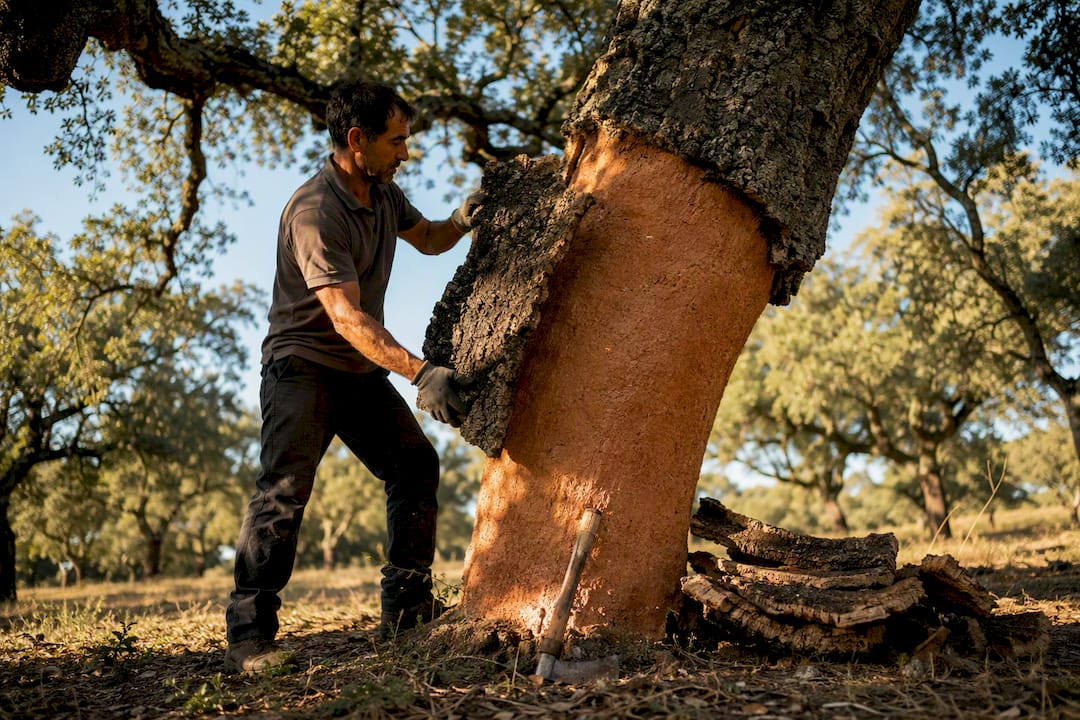
That regrowth cycle is the foundation of every renewability claim you’ll see on a product tag. Trees are never cut down for bark. The forest stays standing, the root systems keep holding soil in place, and the same stand keeps producing raw material decade after decade. This is the structural difference between cork and most “renewable” marketing language you see elsewhere: cork’s renewability isn’t a supply-chain choice, it’s a biological trait of the tree.
Cork shows up in more places than wine bottles. Common applications include:
- Wine and spirit closures (the original, highest-volume use)
- Flooring underlayment and finished cork floor tiles
- Building insulation, both rigid board and loose granulate
- Automotive gaskets and vibration dampening
- Consumer goods: yoga mats, bulletin boards, footwear, bags
Cork tends to outperform synthetic alternatives on two fronts: acoustic and thermal insulation (its cellular structure traps air extraordinarily well) and compressibility without structural fatigue, which is why it recovers its shape after repeated compression better than most foams. Where cork loses ground is anywhere the finished product depends heavily on industrial processing rather than the raw bark itself, which is where a lot of sustainability claims start to wobble.
What do carbon footprint studies actually say about cork?
The oft-cited stopper comparison is worth stating precisely because the numbers matter more than the headline. A PricewaterhouseCoopers life-cycle study commissioned via Amorim found that manufacturing 1,000 natural cork stoppers generates roughly 1.5 kg of CO2 equivalent, compared with about 14 kg for 1,000 plastic stoppers and 37 kg for 1,000 aluminium screw caps.
Statistic: Natural cork stoppers produce roughly 9 times less CO2 than plastic closures and about 24 times less than aluminium screw caps, per unit of 1,000 pieces, according to the same comparative study.
Part of that gap comes from biogenic carbon accounting, a concept researchers and procurement teams need to understand before repeating any cork carbon claim. Cork bark stores carbon the tree pulled out of the atmosphere while it grew. Life-cycle methodologies vary on how they treat that stored carbon: some count it as a net removal for as long as the product is in use, others treat it more conservatively. This is not a footnote. It changes whether cork looks “carbon negative” or merely “low carbon” on paper, and dynamic carbon-footprint modelling of the cork sector shows the two accounting approaches can produce meaningfully different results for the same product.
Where cork’s advantage holds up best is in long-life, minimally processed uses: floor tiles, wall panels, natural wine stoppers, raw cork sheet. Where it gets shakier is anywhere the bark undergoes energy-intensive transformation. Expanded cork agglomerate, the steam-baked insulation board sold as ICB, depends heavily on how that steam is generated. A peer-reviewed life-cycle assessment of insulation cork board found impacts are highly sensitive to methodological choices and energy sourcing during processing, meaning the same insulation product can carry a very different footprint depending on the factory behind it.
Pro Tip: Don’t take a supplier’s word for “carbon negative.” Ask for an EN 15804 Environmental Product Declaration. It spells out exactly which carbon accounting method the manufacturer used, so you can compare products on equal footing instead of comparing marketing copy.
Why cork oak forests matter beyond the material itself
Cork forests deliver benefits that never show up on a product label but matter enormously to anyone assessing the material’s real environmental footprint. The Iberian montado and dehesa landscapes, low-density cork oak woodlands grazed by livestock and dotted with wild pasture, are among the most biodiverse agroforestry systems in the Mediterranean.
These landscapes function as working ecosystems, not tree farms. Cork oak systems support:
- Endangered species including the Iberian lynx and Iberian imperial eagle
- Soil protection and erosion control on land otherwise prone to desertification
- Natural fire resistance, since cork bark itself doesn’t burn easily
- Groundwater regulation across otherwise dry Mediterranean terrain
- Rural employment tied directly to continued, active harvesting
That last point explains why cork forests survive at all. A cork oak only earns its keep if someone harvests its bark. Industry and conservation sources note that when demand for cork drops, landowners have less incentive to maintain the forest, and neglected montado is at far greater risk of being cleared for other land uses. Buying cork, in other words, isn’t just a material choice. It’s one of the few consumer decisions that directly funds the survival of a specific, threatened landscape type. Peer-reviewed synthesis work on cork oak systems also points to landscape-scale carbon retention, though exact sequestration figures vary by region, tree density, and soil type.
How manufacturing and end-of-life change cork’s footprint
Raw cork bark is one thing. What happens to it in the factory is another, and that gap is where a lot of “eco-friendly” claims quietly fall apart.
- Raw sheet processing involves boiling, flattening, and punching, which is comparatively low energy and low waste, since offcuts get ground into granulate for other products.
- Expanded cork agglomerate requires high-temperature steam to bind cork granules with their own natural resins, and this step is where energy source matters most, per the insulation cork board life-cycle assessment.
- Composite cork products, anything bonding cork to synthetic rubber, plastic, or glue-heavy backing, gain performance (grip, cushioning, water resistance) but usually lose easy recyclability in the trade.
- End-of-life routes split depending on composition: pure cork biodegrades over roughly one to two years in typical composting conditions, can be reground into new products, or can be safely incinerated for energy recovery, since combustion releases only the biogenic carbon the bark already stored.
Mixed-material goods are the sticking point most shoppers overlook. Once cork is bonded to synthetic rubber for grip or durability, standard recycling streams generally can’t separate the two materials cleanly. That doesn’t make the product unsustainable on its own, but it does mean the “cork is biodegradable” claim doesn’t automatically transfer to every cork-containing product on a shelf. Ask the manufacturer directly what happens to the item at end of life, and don’t assume the cork content alone answers that question.
Which certifications actually verify a cork product’s claims?
Marketing copy is free. Certification isn’t, which is exactly why it’s a better signal. A handful of credentials separate a genuinely verified cork product from one riding on the material’s general reputation.
- EN 15804 Environmental Product Declarations disclose the exact life-cycle methodology and system boundaries a manufacturer used, letting you compare products on the same basis instead of trusting a claim at face value.
- FSC or PEFC chain-of-custody certification confirms the cork oak forest itself is managed under an audited sourcing standard, tracked from forest to finished product.
- ISO 14001 signals the manufacturing facility runs a certified environmental management system, which speaks to process controls rather than the raw material.
Watch for red flags: vague phrases like “sustainably sourced” with no certification named, no mention of what happens to the product at end of life, or a “natural material” claim on something that’s actually a cork and plastic composite. For any mixed-material item, sector guidance on cork sustainability recommends asking the seller two direct questions: what percentage of this product is cork versus synthetic material, and does the company offer any take-back or recycling program for it.
Pro Tip: If a product page doesn’t name a certification body, that’s not proof it’s unsustainable, but it does mean you’re trusting the seller’s word over an independent audit. Ask before you buy, not after.
How Crk builds cork into its yoga products
The products use organic cork paired with natural rubber, chosen for grip that improves rather than degrades when you sweat, and for antimicrobial properties that cut down on the odour buildup common in PVC and foam mats. The surface texture also underpins an alignment system, printed guides that help you position hands and feet without breaking focus mid-pose.
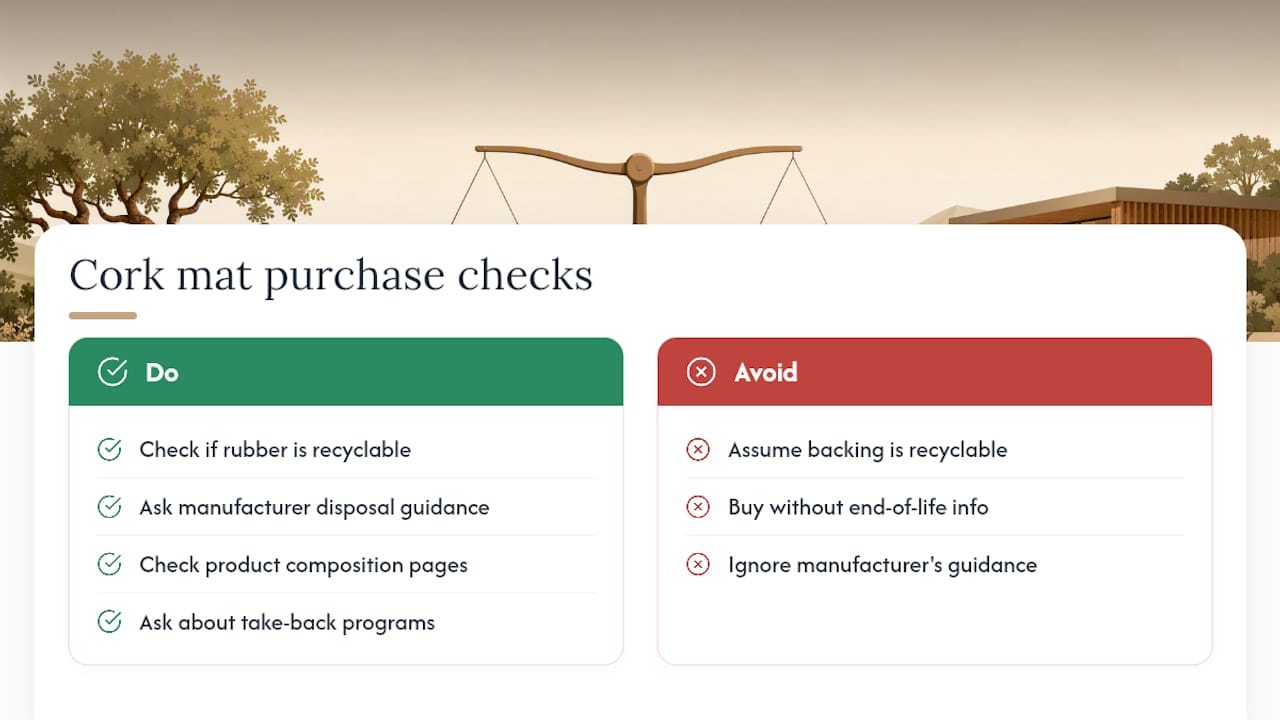
If you’re applying the checks covered above to a mat purchase, two questions are worth asking before you buy any cork and rubber composite: is the rubber component recyclable on its own, and what’s the manufacturer’s guidance for disposing of the product once it wears out? The Flowers Mat and Moon Mat product pages list material composition directly, which is the starting point for that conversation.
Composite products like these carry the same end-of-life caveat as any cork and synthetic blend: the rubber backing generally isn’t separable through standard recycling. If that matters to your purchase decision, contact the manufacturer directly and ask about take-back or end-of-life programs before checkout, the same way you would with an insulation supplier’s EPD.
Where cork earns its reputation, and where to stay skeptical
Cork’s core claim holds up. Harvest without felling, centuries-long tree life, and a genuine carbon advantage in long-life uses are backed by real data, not just goodwill. Where the reputation gets overstated is anywhere a marketer skips from “cork is renewable” to “this cork product is automatically low-impact,” without acknowledging that steam processing and composite bonding change the math.
The practical rule: favour minimally processed, long-life cork goods, and demand an EPD or certification before trusting a carbon claim on anything industrially transformed. Manufacturers that publish standardized life-cycle data are the ones worth rewarding with your purchase. Manufacturers that only publish adjectives are asking you to take their word for it.
— Crk
Buying cork products that back up the claims
There are a few routes to buying cork goods with your eyes open: raw cork flooring suppliers, insulation manufacturers who publish EPDs, and mat or accessory brands built around the material from day one. Some brands build their entire product lines around organic cork and natural rubber rather than bolting cork onto a synthetic base as an afterthought.
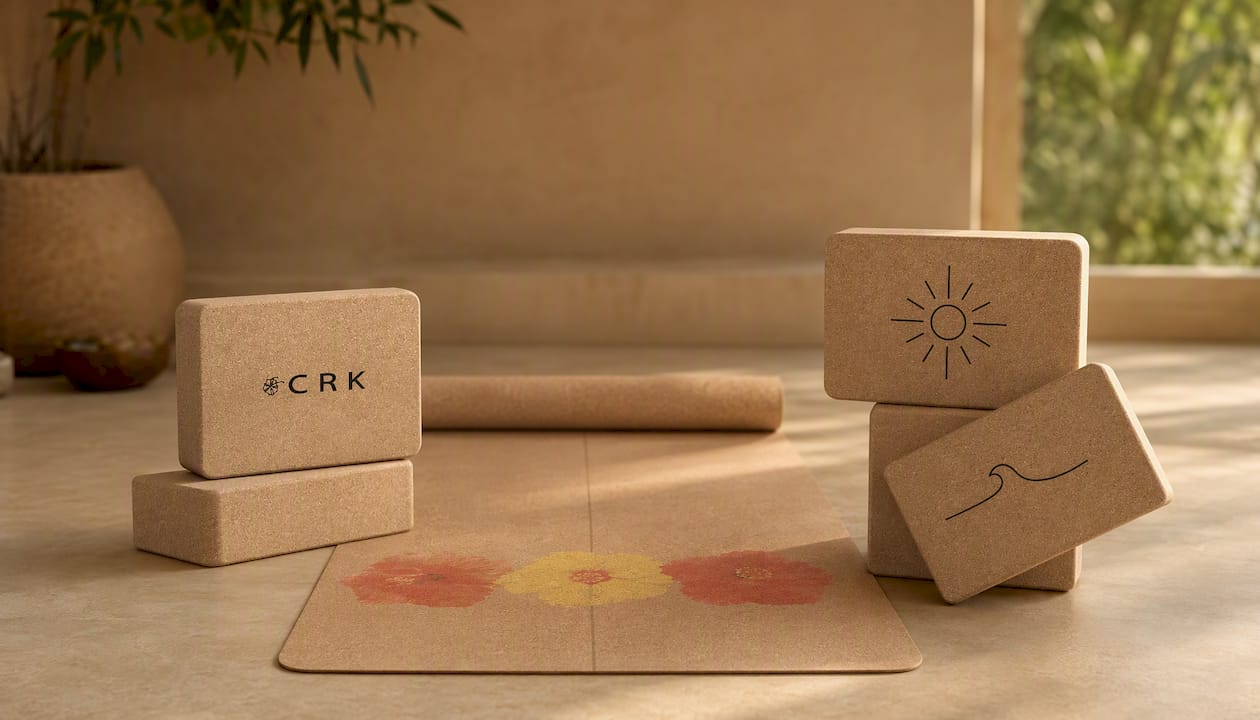
The lineup includes The Crk Block, a 3 inch organic cork yoga block, alongside the Sun & Wave cork blocks for a different finish on the same material. For mat shoppers, the Flowers Mat pairs a 5mm organic cork surface with natural rubber for grip that holds up through hot yoga sessions. Product pages list material composition up front, so shoppers can run the same verification checks covered above before purchasing. If end-of-life recycling matters to your decision, reach out to customer support directly and ask what happens to the mat or block once it’s done its job. Ready to see the specs for yourself? Check the Flowers Mat product page for full material details and current availability.
Sources
For deeper reading beyond this article, the PwC and Amorim cork carbon footprint study, the insulation cork board life-cycle assessment, and the peer-reviewed synthesis on cork as a strategic material cover the primary data behind most claims made industry-wide.
- Analysis of the life cycle of Cork, Aluminum and Plastic Wine Closures (PwC summary via Amorim)
- Cork: a strategic material - Frontiers in Chemistry / PMC
- Insulation Cork Boards—Environmental Life Cycle Assessment of an Organic Construction Material - PMC
- Environmental & social benefits | Why Cork > Amorim Cork Solutions
FAQ
Is cork material eco-friendly?
Cork is generally eco-friendly because harvesting doesn’t kill the tree and raw cork production carries a low carbon footprint, though heavily processed or composite cork products can lose some of that advantage.
How long does it take cork to biodegrade?
Pure, untreated cork typically biodegrades within one to two years under normal composting conditions; products blending cork with synthetic rubber or plastic take considerably longer and may not fully break down at all.
What is the environmental impact of corks made for wine bottles?
Producing 1,000 natural cork wine stoppers emits about 1.5 kg of CO2, far below the 14 kg for plastic stoppers and 37 kg for aluminium screw caps of the same quantity.
Is there a shortage of cork in the world?
No global cork shortage exists; cork oak forests regenerate bark every nine to 12 years and the trees live for centuries, though demand shifts toward synthetic closures have reduced incentives to maintain some cork oak land in recent decades.


